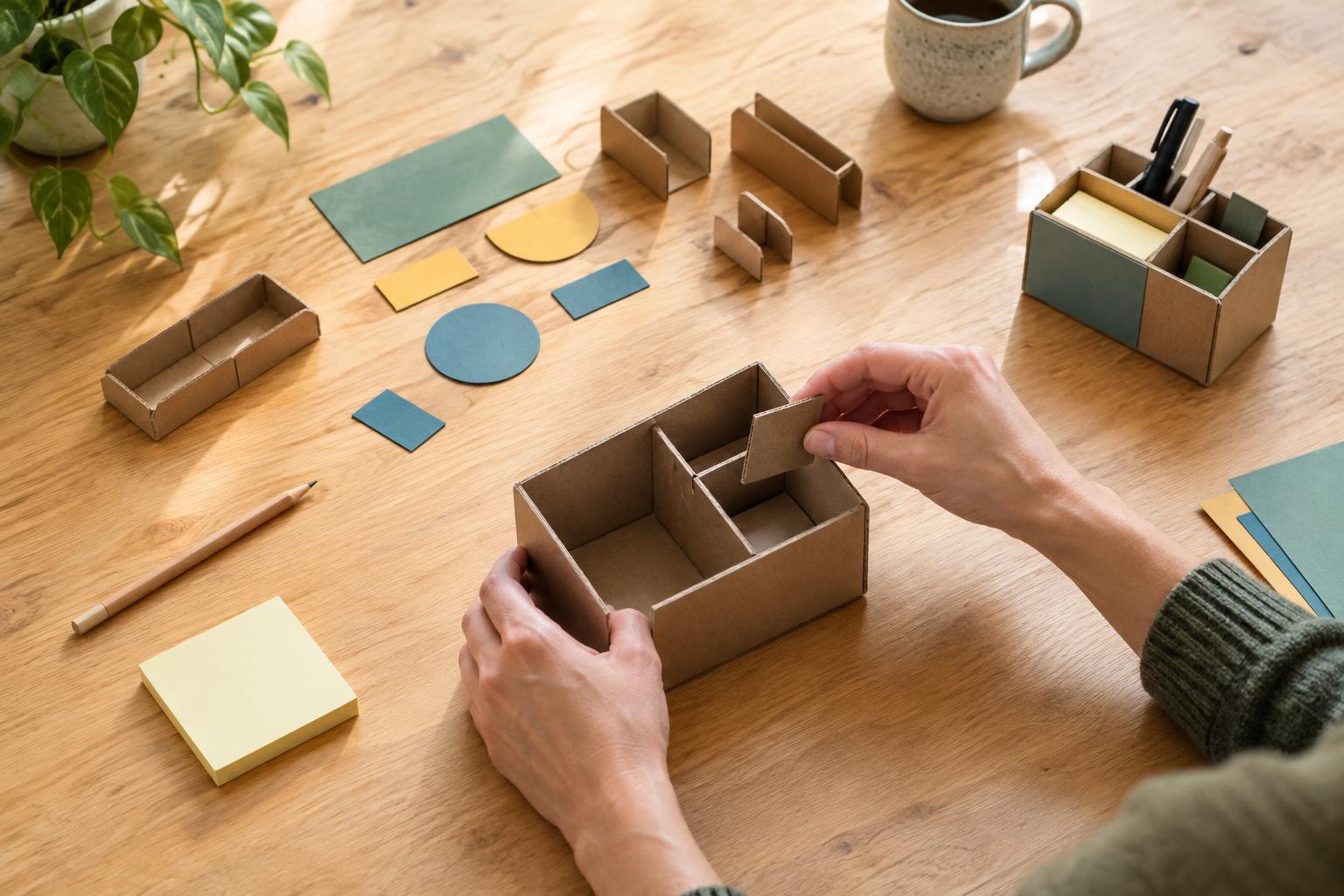
Why a smaller space can help
When a problem has no boundaries, every possible direction competes for attention. You might spend more time deciding where to start than developing an idea. A constraint narrows the field. It gives you something specific to work with, whether you are planning a lesson, organizing a small room, writing a story or improving a routine.
A constraint is not automatically helpful. “Make it better” is too vague to guide a decision, while “make it shorter” may be too narrow if length is not the real problem. Useful constraints connect to the task: a limited amount of time, a particular audience, available materials or a required outcome. The goal is not to make work difficult for its own sake. It is to turn an open-ended challenge into a question you can answer.
Separate fixed limits from chosen ones
Start by writing down what genuinely cannot change. Perhaps you have one hour, cannot buy new supplies, or need a solution that a beginner can understand. Then list your assumptions separately. “This must be done on a computer” may be an assumption, not a requirement. Keeping the two lists apart prevents an invented rule from quietly ruling out a promising approach.
Next, add one temporary constraint of your own. If you are designing a way to share instructions, try making a version that uses only five sentences. If you are finding uses for leftover materials, try using only what fits in one box. Chosen limits are experiments, not permanent rules. You can loosen, replace or discard them once you see what they reveal.
Generate ideas before judging them
Try this exercise with a real problem: write it as a question, such as “How could I make my weekly study review easier to start?” Choose one constraint and set a short period for generating options. For example, every idea must take less than ten minutes, require no new app or begin with something already on your desk. Write several possibilities without deciding yet whether they are good. A rough list gives you material to compare; an early verdict can stop the list at the first familiar answer.
If the ideas all look alike, change the constraint rather than pushing harder in the same direction. Ask what you would do if the solution had to work without a screen, be explained to a friend or fit into an existing habit. Each change shifts your attention toward different features of the problem. One version might suggest a paper checklist; another might suggest a spoken recap while putting away your notes. Neither must be the final answer to be useful.
Combine and test the strongest options
After generating ideas, look for parts that work well together. You might pair the simplicity of a paper checklist with the convenience of leaving it beside your notes. Then test the combination at the smallest practical scale. Use it once, make a quick sample, or explain it to someone who has not heard your plan. A small test can expose steps you overlooked without requiring you to commit to a complete redesign.
Judge the result against the original need, not just the cleverness of the idea. Did the constraint help you make something clearer, easier to use or more suitable for the people involved? What did it make worse? A five-sentence explanation may be easy to read but leave out a necessary step. That does not mean the experiment failed: it tells you which limit to adjust. You could allow seven sentences or keep the short version and add a simple example.
Keep constraints flexible
Constraints are most useful when they create movement. If a limit repeatedly blocks you, check whether it belongs to the problem at all. An audience need or safety requirement may be non-negotiable, while a self-imposed format is usually open to change. You can also alternate between a tight limit and an open round: generate ideas using only existing materials, then ask what you would add if resources were available. The contrast can show which additions would actually matter.
For your next creative task, begin with one real boundary and one chosen constraint. Produce a few options, test one, and note what the limits helped you notice. Over time, this habit can make constraints feel less like obstacles and more like tools for asking better questions. Inventiveness does not require unlimited choices; it often starts with a clearer view of the choices you have.