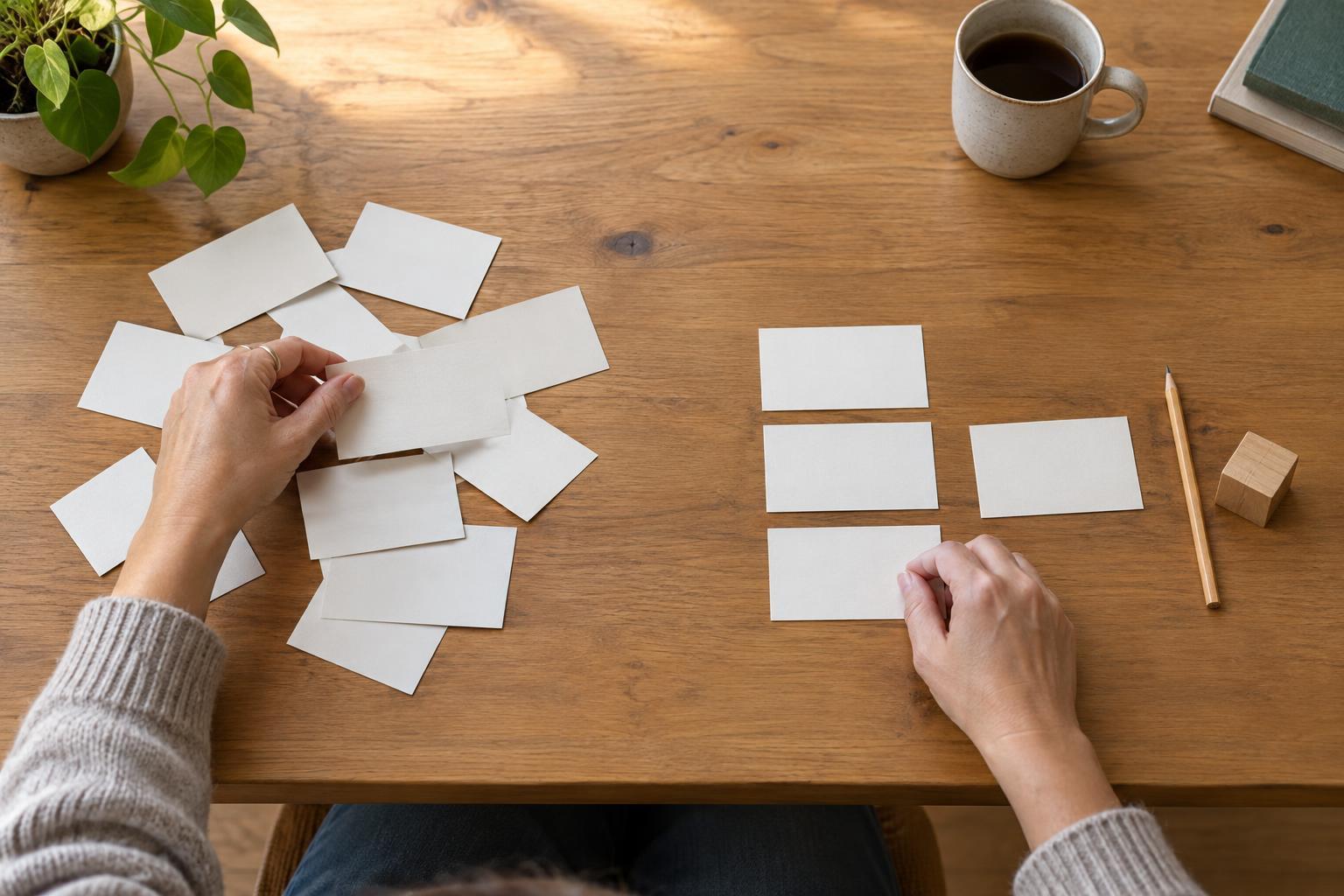
Why brainstorm on your own?
Brainstorming does not require a group. If you are planning a learning project, solving a household problem, or looking for a fresh way to explain something, you can explore possibilities with a page and a timer. Working alone lets you follow an unusual thought without having to defend it immediately. The challenge is that you may circle the same few ideas unless you give yourself a structure.
A timed exercise separates two jobs that often interfere with each other: generating ideas and judging them. At first, your aim is not to find the best answer. It is to create enough options that you have something to compare. Set aside about 25 minutes, use paper or a simple document, and silence distractions if you can. The time limits are guides, not a test; adjust them if you need a slower pace.
Minutes 0–5: Frame a question you can work with
Write one question at the top of your page. Make it specific enough to suggest action but open enough to allow several answers. “How can I make my study routine better?” is broad. “What are different ways I could review new vocabulary during a 15-minute bus ride?” gives your mind a clearer starting point. If your first question already contains a preferred solution, rewrite it so other approaches remain possible.
Below the question, note two or three useful constraints. These might be the time you have, materials you can access, or the needs of the people involved. Constraints keep the exercise connected to real life, but avoid turning them into reasons to reject ideas yet. If you are stuck before starting, write a question beginning with “What are five ways to…” and choose a small part of the problem.
Minutes 5–15: Generate without editing
Set a timer for ten minutes and make a numbered list. Write each idea as a short phrase rather than a polished plan. Include ordinary answers, variations of answers, and options that seem impractical. If an idea occurs to you twice, ask what makes the second version different. Keep the pen or cursor moving; when you stall, write “another way” and finish that thought.
Use prompts to change direction when your list slows down. What could you remove, combine, reverse, or simplify? What would you try with no equipment? What would you do if you had only five minutes? For the vocabulary question, your list might include naming objects you pass, making one sentence with each new word, or recording a short voice note. You are collecting possibilities, not committing to any of them.
Resist checking whether every idea will work. Early evaluation can lead you to repeat only familiar solutions. If a thought is clearly unsuitable, you can still write it down and move on. It may point toward a more useful variation later.
Minutes 15–20: Change your point of view
Take a brief pause, then return to your list with a different prompt. Imagine you are designing an option for a beginner, for someone with very little time, or for someone who dislikes your usual approach. Add at least three ideas from that perspective. You can also ask what the opposite of your most obvious idea would be. If your first plan depends on doing more, what might work by doing less?
This round is especially helpful when your first list contains several versions of the same answer. Do not worry about making every new idea realistic. The purpose of the shift is to expose assumptions you may not have noticed, such as the belief that practice must happen at a desk or that a project must be finished in one sitting.
Minutes 20–25: Choose a small test
Only now, read the whole list. Mark one idea that is easy to try and one that is intriguing, even if it needs adjustment. For each, ask: What would I need to begin? What might make this difficult? What could I learn from trying a small version? These questions help you select an experiment rather than declare a winner.
Finish by writing one next action with a clear stopping point, such as “Try voice-note sentences on my next bus ride” or “Sketch three layouts before deciding on one.” Keep the full list. An idea that does not fit today’s constraints may suit another project, and combining two modest ideas may be more useful than waiting for one perfect answer.