Why the usual use comes to mind first
Pick up a mug and you probably think of a drink. That quick association is useful: it lets you move through daily tasks without reconsidering every object you touch. But when you need an improvised solution, the same habit can narrow your options. Functional fixedness is the tendency to see an object mainly in terms of its familiar purpose, even when another use might help with the problem at hand.
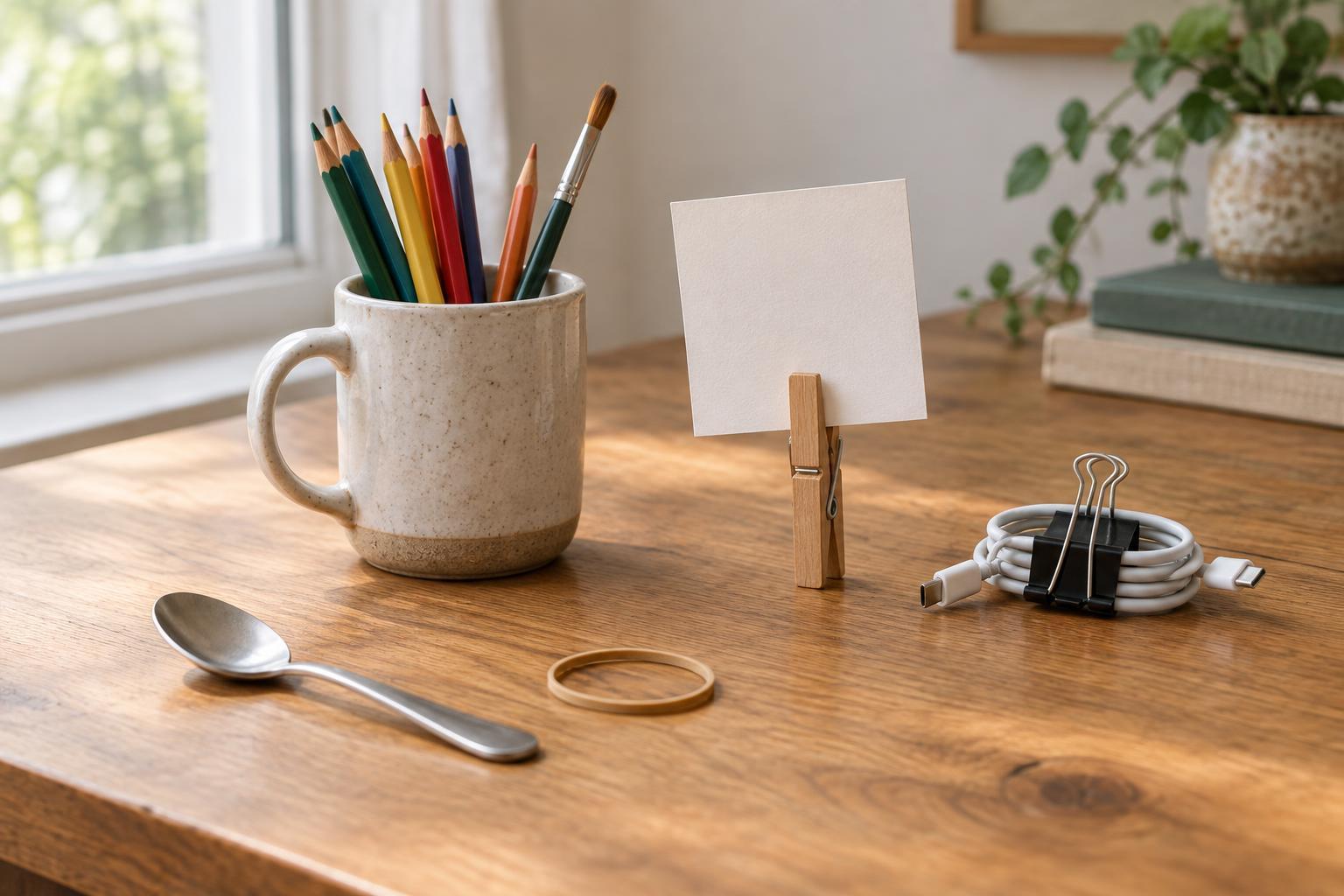
The aim is not to invent a surprising use for everything. It is to notice when a familiar label is limiting your choices. A mug is also a container with a handle, a stable base, an open top, and some weight. Describing those features gives you more to work with than the word “mug” alone. A spare mug might hold pencils on a desk, for example, because its shape suits that task—not because it has stopped being a mug.
Start with properties, not names
Try this exercise with an ordinary object such as a binder clip. First, write its name and usual purpose. Then set that purpose aside for two minutes. List only what you can observe: it grips, opens and closes, has two movable handles, is small, and can be attached to a thin edge. Avoid writing possible uses yet. This separates observation from judgment and makes it easier to spot a property you normally overlook.
Next, choose a small problem: keeping a charging cable from slipping behind a desk, holding several notes together, or marking a page in a folder. Ask which listed properties the problem calls for. The clip may be suitable for some of these tasks, depending on its size and the surfaces involved. If it is not, that is still a useful result. You have tested the match between a need and an object's features rather than relying on the first idea that came to mind.
Change the question to generate options
When you are stuck, “What else can I do with this?” may be too broad. Ask smaller questions instead: What could this hold, separate, protect, support, mark, or carry? What happens if I turn it over, combine it with another item, or use only one part? These prompts shift attention from the object's standard role to the actions its features might allow.
You can also work backward from the task. Suppose loose papers keep spreading across a table. Write down what the solution must do: contain the sheets, keep them accessible, and fit the available space. Then look around for objects with a suitable shape or boundary. A shallow tray, an empty folder, or a clean box lid might work. Working backward helps prevent a common mistake: becoming so attached to a clever object that you overlook a simpler solution.
Separate idea generation from testing
For a quick practice round, choose one object and set a five-minute timer. Write down as many possible uses as you can without stopping to debate each one. Include ordinary ideas alongside unusual ones. After the timer ends, sort the list into three groups: useful now, worth testing, and impractical. This two-stage approach gives tentative ideas room to develop while still making space for judgment.
Before trying an idea, check the conditions that matter. Will the object stay stable? Could it scratch a surface, damage equipment, or create a tripping or fire hazard? An object that works as a desk organizer may be unsuitable near heat, food, electricity, or heavy loads. A good alternative use solves the original problem without introducing a more serious one. If the test fails, note why: size, material, grip, weight, or location. That observation can guide your next attempt.
Make flexible thinking a small habit
You do not need a special project to practice. During a routine task, pick one object and describe it without saying its name. On another day, take a minor inconvenience and list the properties a solution would need before naming any tools. These short exercises can help you become more deliberate about how you frame a problem.
Keep a brief record of attempts, including ideas that did not work. “The box lid held the papers but was too wide for the shelf” is more useful than “bad idea.” It identifies a constraint for the next search. Over time, the goal is not to stop seeing objects for what they are meant to do. It is to have a second way of looking when their usual purpose does not meet your needs.