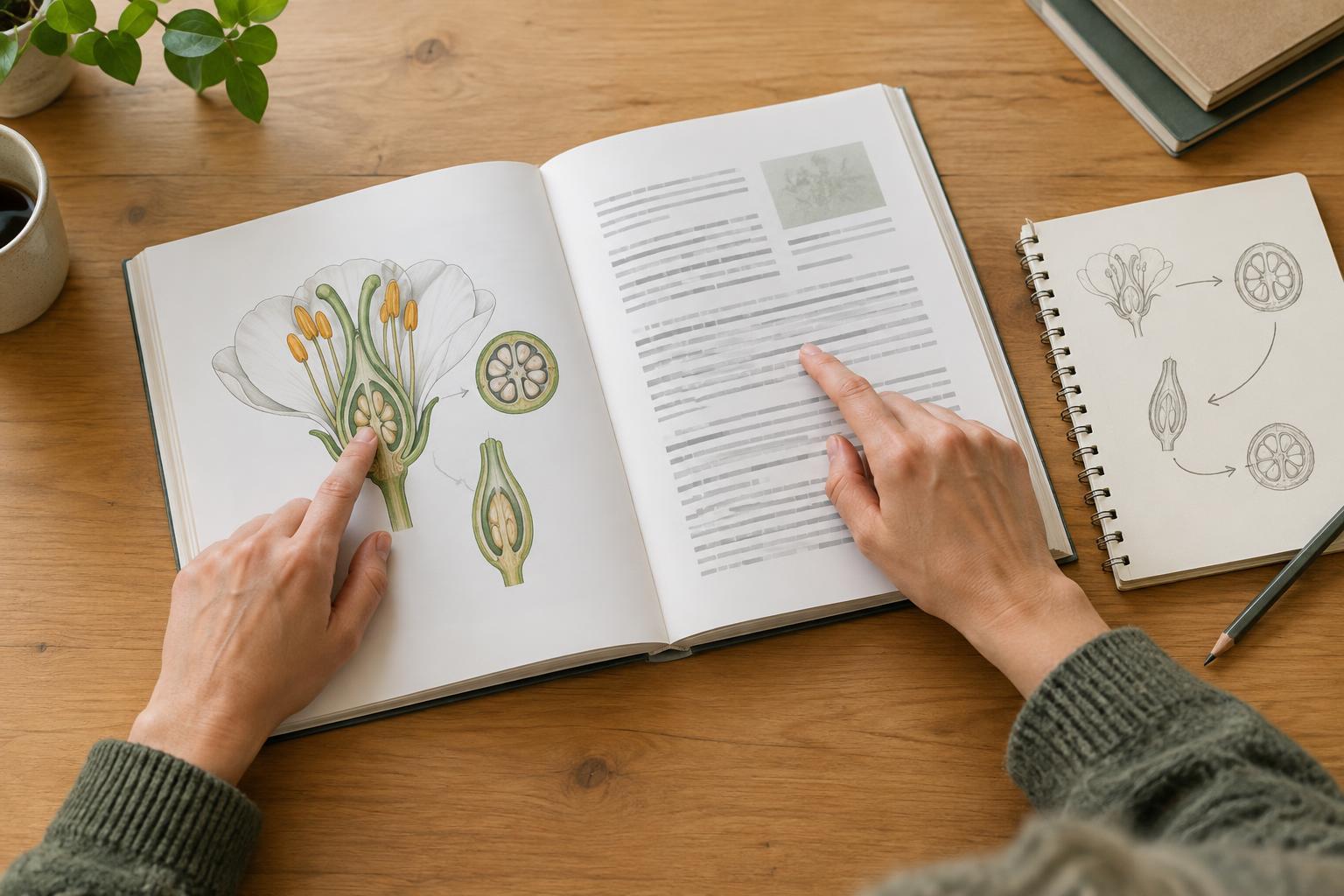
Treat the visual and the text as one explanation
It is easy to read a textbook paragraph, glance at the nearby picture, and move on. But a chart or diagram may carry information the prose does not repeat: a pattern across categories, the order of a process, or the relationship between parts. The paragraph may supply context that the visual leaves out. Reading them together helps you see what each contributes.
Start with a quick orientation rather than a detailed inspection. Read the section heading and the paragraph that introduces the visual. Then look at its title, caption, labels, and any legend or key. Ask, “What question is this visual meant to help answer?” Keeping that question in mind gives your eyes a purpose when you return for a closer look.
Identify what kind of information you are looking at
Different visuals call for different reading moves. In a chart, check the axes, units, categories, and scale before comparing values. A line chart might invite you to trace change across its horizontal axis; a bar chart might make differences between categories easier to spot. Notice where an axis begins and whether intervals are evenly spaced. These details affect how you interpret the shape or size of a difference.
In a diagram, follow arrows, numbering, and spatial groupings. Arrows may show sequence, movement, or a relationship, so use the caption and surrounding text to decide what they mean. A labeled drawing of a system may show where components sit, while a flow diagram may show what happens next. Do not assume that the largest or most colorful feature is the most important one; look for what the author asks you to notice.
If the visual is dense, examine one path or comparison at a time. Cover other parts with a sheet of paper or use a finger to trace a route. Breaking the visual into smaller questions can make it easier to read without losing the overall picture.
Move back and forth instead of reading in one direction
After your first look, return to the relevant paragraph and find the sentence that points to the visual. It may describe a trend, name a stage, or explain why a relationship matters. Locate that same detail in the chart or diagram. Then ask what the visual adds: Does it show the size of a difference, an exception to the general description, or a connection the prose describes only briefly?
Next, reverse the process. Choose one feature in the visual and explain it using the text. For example, if a diagram shows three connected steps, see whether the prose explains what changes at each step. If a chart has an unexpected dip or a category unlike the others, check whether the author discusses it. A feature can be worth noticing even when the prose does not explain it, but avoid inventing a reason for it.
Pay attention to scope. A sentence may describe a broad principle while the visual shows one example. A chart may display a limited set of categories rather than every possible case. Words such as “may,” “often,” and “in this example” help you avoid turning a qualified explanation into an absolute rule.
Make a short note that combines both sources
Copying every label rarely helps as much as writing a short explanation in your own words. Try a three-part note: what the text says, what the visual shows, and how the two connect. For instance: “The paragraph describes the stages of a process. The arrows show their order. The caption clarifies that one stage can repeat.” This note records the relationship, not just isolated facts.
For a chart, write a comparison that names the units or categories involved rather than saying only that one bar is “higher.” For a diagram, describe the direction of an arrow or the role of a labeled part. If you cannot explain a connection without looking back, mark the exact label or sentence that is confusing. A specific question is more useful for a second reading than a general note saying “review diagram.”
Check understanding before moving on
Close the book or look away and describe the main point aloud or in one or two sentences. Can you state both the claim in the prose and the evidence or structure shown visually? Then reopen the page to check what you omitted or overstated. This quick test can reveal whether you understood the relationship or merely recognized the image.
As a final check, imagine removing either the text or the visual. What would become harder to understand? If the answer is unclear, revisit the caption, labels, and nearby explanation once more. With practice, this back-and-forth routine becomes a way to read the page as a connected argument rather than as separate blocks of words and pictures.