Why preview a chapter?
Opening a chapter at the first sentence and reading straight through can work well when the subject is familiar. With an unfamiliar or demanding chapter, though, it is easy to lose track of how the details fit together. A preview gives you a rough map before you begin. You are not trying to learn everything in advance; you are looking for the chapter’s purpose, its major parts, and a few questions to guide your reading.
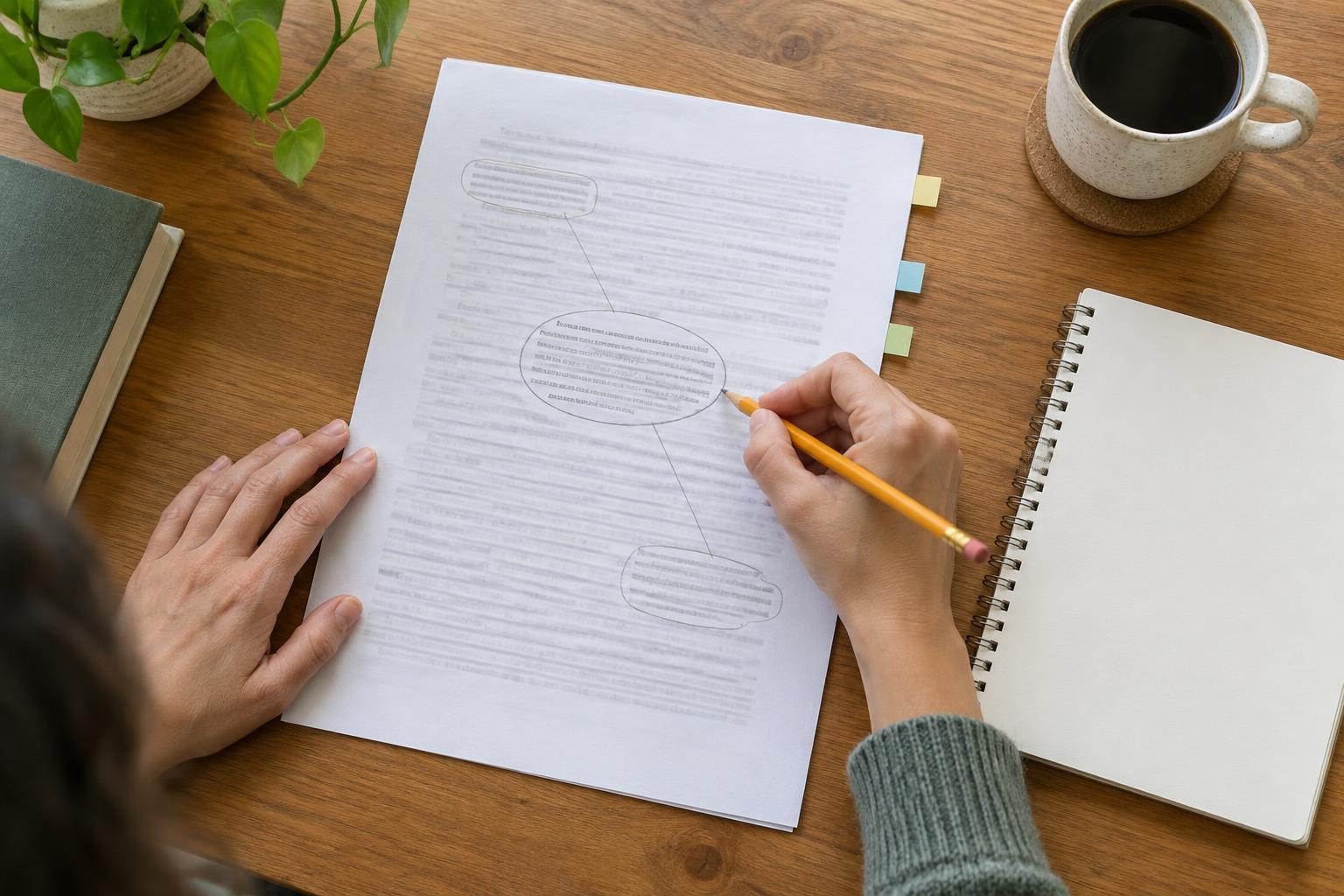
Set a short, flexible limit for the preview, perhaps a few minutes for a short chapter and longer for a dense one. Keep a notebook or blank page nearby. Write only brief notes at this stage. If you find yourself copying whole paragraphs or trying to resolve every unfamiliar term, return to the task of finding the overall shape.
Use headings to find the route
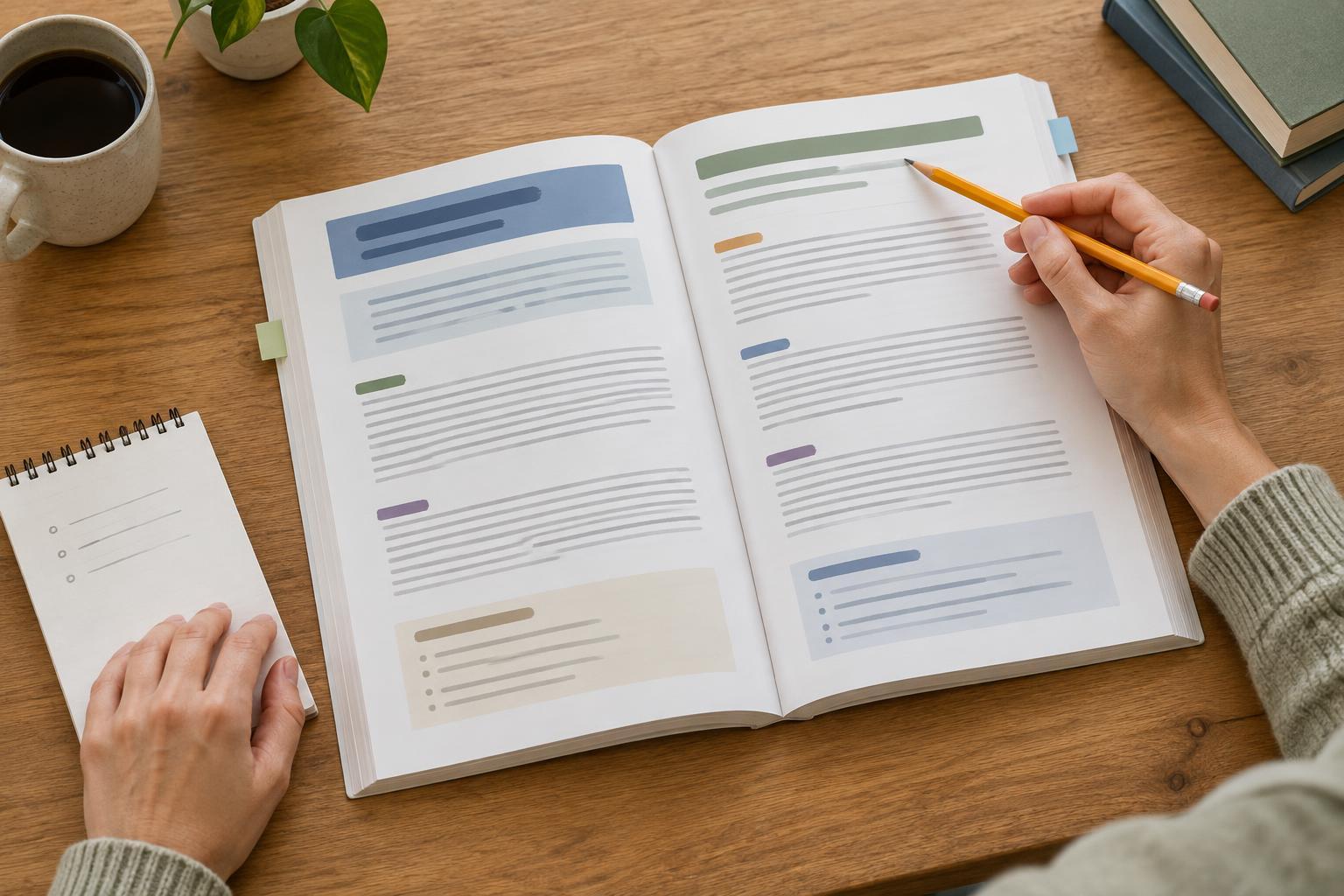
Start with the chapter title, then scan the main headings and subheadings in order. Notice whether they suggest a sequence, a comparison, a problem and solution, or a set of related concepts. A chapter with sections called “Causes,” “Effects,” and “Responses,” for example, appears to move from explanation to consequences to possible actions. That expectation may change once you read, but it gives you a place to start.
Turn two or three headings into questions. If a section is titled “Common Obstacles,” ask, “Which obstacles matter most, and why?” If a heading contains a term you do not recognize, note the term without stopping for an extended search. Looking at all the headings first can also reveal where a definition or example is likely to appear later.
Headings are signposts, not a complete account of the argument. Some are playful or vague, and some chapters have few subheadings. Treat your first map as a guess to test against the text, rather than a set of conclusions to memorize.
Read the introduction for purpose and scope
Next, read the opening paragraphs. Look for the central question, the reason the topic matters, and any explanation of what the chapter will cover. An introduction may also name ideas from an earlier chapter that you need to understand. If it begins with a story, ask what problem the story illustrates before deciding that the story itself is the main point.
Write a one-sentence prediction in your own words: “This chapter seems to explain how…” or “This chapter compares…” Leave room to revise it. The goal is not to guess perfectly. Putting a prediction into words makes it easier to notice when the chapter takes a different direction.
If the introduction is long, read its first and last paragraphs closely, then skim the middle for stated aims and key terms. Do not assume every opening announces a clear thesis. In a practical guide, the introduction may instead describe a task you will learn to do.
Check the summary, then connect the pieces
If the chapter has a closing summary, review it before reading the body. Look for ideas that appear both there and in the headings. Repeated terms often indicate concepts worth watching for. Notice, too, whether the summary describes a conclusion, lists steps, or highlights distinctions. Add one or two questions that the summary raises but does not answer for you.
For instance, a chapter might introduce several approaches in its headings but conclude that each suits a different situation. Your preview question could be, “What conditions make each approach useful?” That question is more helpful than simply listing the approach names. If there is no summary, look for a brief conclusion or final paragraph. If neither exists, rely on the introduction and headings rather than hunting for a feature the chapter does not have.
Turn the preview into a reading plan
Before reading closely, take a moment to record three things: the chapter’s likely main point, its major parts, and the questions you want answered. Then read with that map in mind. Slow down when you reach a section that addresses one of your questions or introduces an important distinction. Move steadily through examples that repeat a point you already understand, unless those examples are needed for your task.
After reading, revisit your preview notes. Correct the main-point sentence, answer the questions you can, and mark anything still unclear. This final check matters because a preview is provisional: its value comes from helping you notice what you understood, what surprised you, and what needs another look. Over time, the routine can help you approach new chapters with a clear purpose without treating every line as equally important.