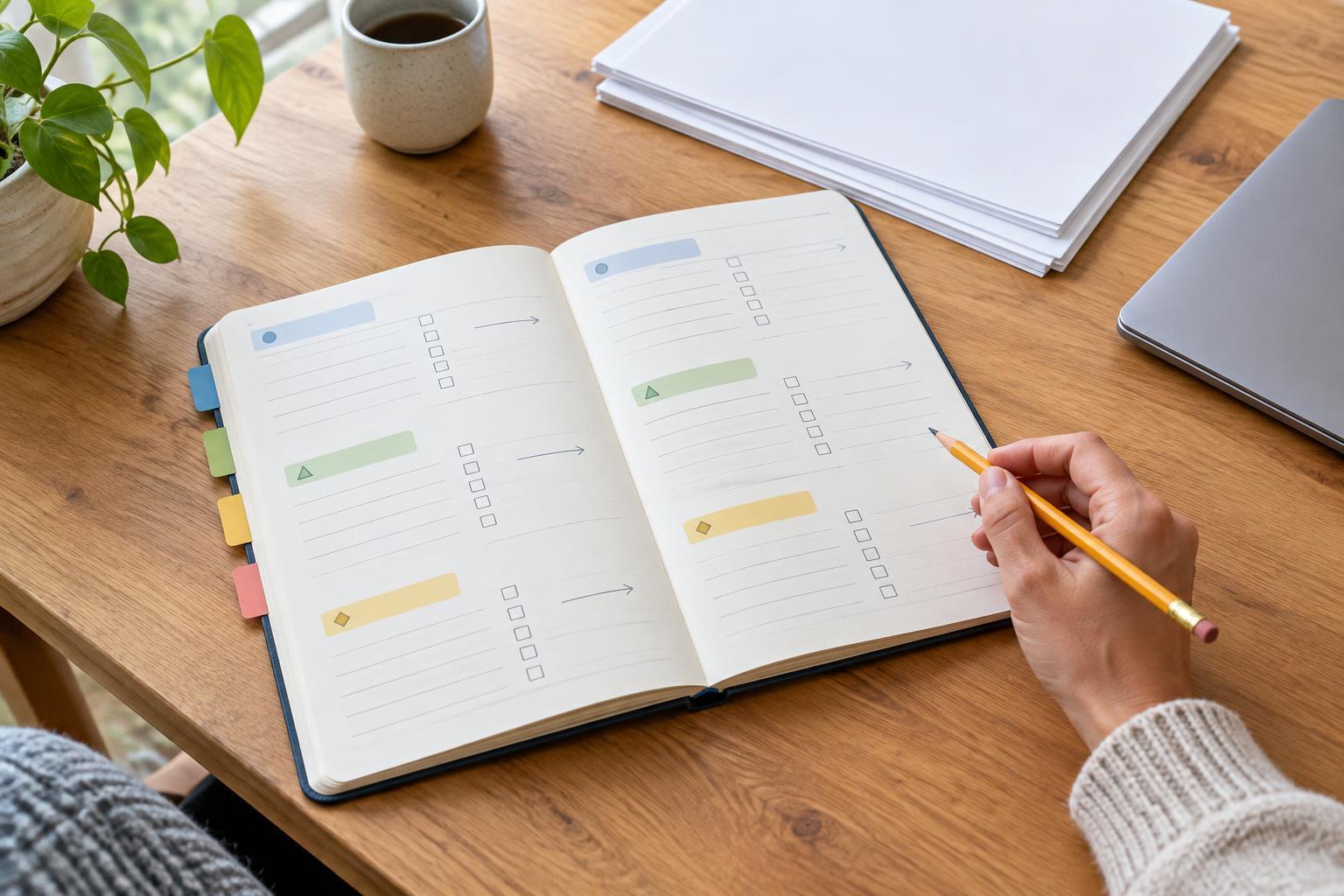
Give the log one clear job
A project log is a running record of the information your future self will need. It is not a diary of every minute you worked or a polished report for someone else. Its main job is to make it easier to pick up the project again, especially after a break. A few useful notes can save you from reconsidering the same decision or repeating an experiment that did not work.
Choose a place you will actually use: a notebook, a document, or a notes app. Keep one log per project, and put new entries in a consistent order. At the top, write the project goal in one or two sentences. If the goal changes, update it and note why. This gives each entry a point of reference without requiring an elaborate planning system.
Use a repeatable entry format
A short template removes the effort of deciding what to write. Begin each entry with the date and a brief description of what you worked on. Then add three prompts: What did I decide? What is in the way? What will I do next? Leave a prompt blank when it does not apply. The log should serve the work, not create extra work.
Aim for enough detail to make the entry understandable later. “Worked on outline” may be too vague, while a full account of every edit may be unnecessary. A more useful note is: “Reordered the outline so the examples come before the explanation; the opening still needs a clearer question.” This records both a change and a reason to revisit the work.
For a long session, write the entry before you stop rather than trying to reconstruct it days later. For a short session, two or three sentences may be enough. If you are interrupted, even an unfinished note such as “Next: compare the two draft introductions” gives you a place to restart.
Record decisions with their reasons
Projects involve choices that are easy to forget: which source to use, which approach to test, what to leave out, or when to change scope. Record the decision and the main reason behind it. You do not need to prove that it was the best possible choice. You need to preserve the thinking that made it sensible at the time.
For example, a person making a family recipe booklet might write: “I’ll organize recipes by occasion rather than by ingredient because relatives tend to remember when a dish was served.” If the structure becomes awkward later, that note makes it easier to judge whether the original reason still holds. It also prevents an abandoned idea from resurfacing as though it were new.
Mark decisions that are provisional. Phrases such as “for now” or “test this after the first draft” distinguish a working choice from a settled one. When you reverse a decision, add a new entry instead of deleting the old one. The change itself may reveal something useful about the project.
Turn obstacles into questions you can act on
An obstacle is more helpful when described precisely. “Stuck on research” gives little guidance. “I have three explanations of this term and need to decide which one fits the intended reader” points toward a next action. Describe what is stopping progress, what you have already tried, and what information or resource might help.
Separate problems you can address now from those you must wait on. If you need a reply from someone, note when you asked and choose another task you can do meanwhile. If a task feels too large, turn the obstacle into a smaller question: What is the first part I can draft, test, sort, or check? A log cannot remove every difficulty, but it can keep a difficulty from becoming a vague reason to avoid the project.
End with a next step and review occasionally
Finish each entry with one concrete next step. “Keep working” is hard to begin; “Draft the first example using the notes on page two” is easier. If several tasks are possible, identify the one you expect to start with. Add any materials you will need so that returning to the project requires less setup.
Skim the log every few sessions. Look for repeated obstacles, decisions that need testing, and tasks that keep moving to the next entry. A recurring problem may call for a smaller scope or a different method. You can also note what has become easier: a solved issue is worth recording because it shows how the project moved forward.
Keep the system light enough to maintain. If entries become long and burdensome, shorten the template. If they are too sparse to help you restart, add one sentence explaining why you stopped where you did. The most useful project log is not the most detailed one; it is the one that reliably connects your last work session to your next action.