Start by hearing the difference
When you begin learning a language, a sound may seem identical to one you already know even when speakers treat the two as different. Your ears are working, but your attention has years of practice sorting speech according to familiar patterns. Rather than trying to memorize a description of the new sound, begin by finding out what you can and cannot yet distinguish.
Choose one contrast at a time: two sounds that learners often confuse, or one unfamiliar sound and the nearest sound in your first language. Listen to short, clear recordings of words containing them. On a first pass, do not imitate. Ask only whether the examples sound the same or different. Then listen again and notice where the difference appears. Is it at the beginning of the word? Does one sound last longer? Does one seem to have more breath, or a different vowel quality? Specific questions give your attention somewhere useful to go.
If you have access to paired words that differ mainly in the sound you are studying, use them for a simple listening check. Play an example without looking at its label, decide which word you heard, and then check. A wrong answer is not a failure; it tells you that you need more listening before judging your own pronunciation by ear.
Look for a physical clue
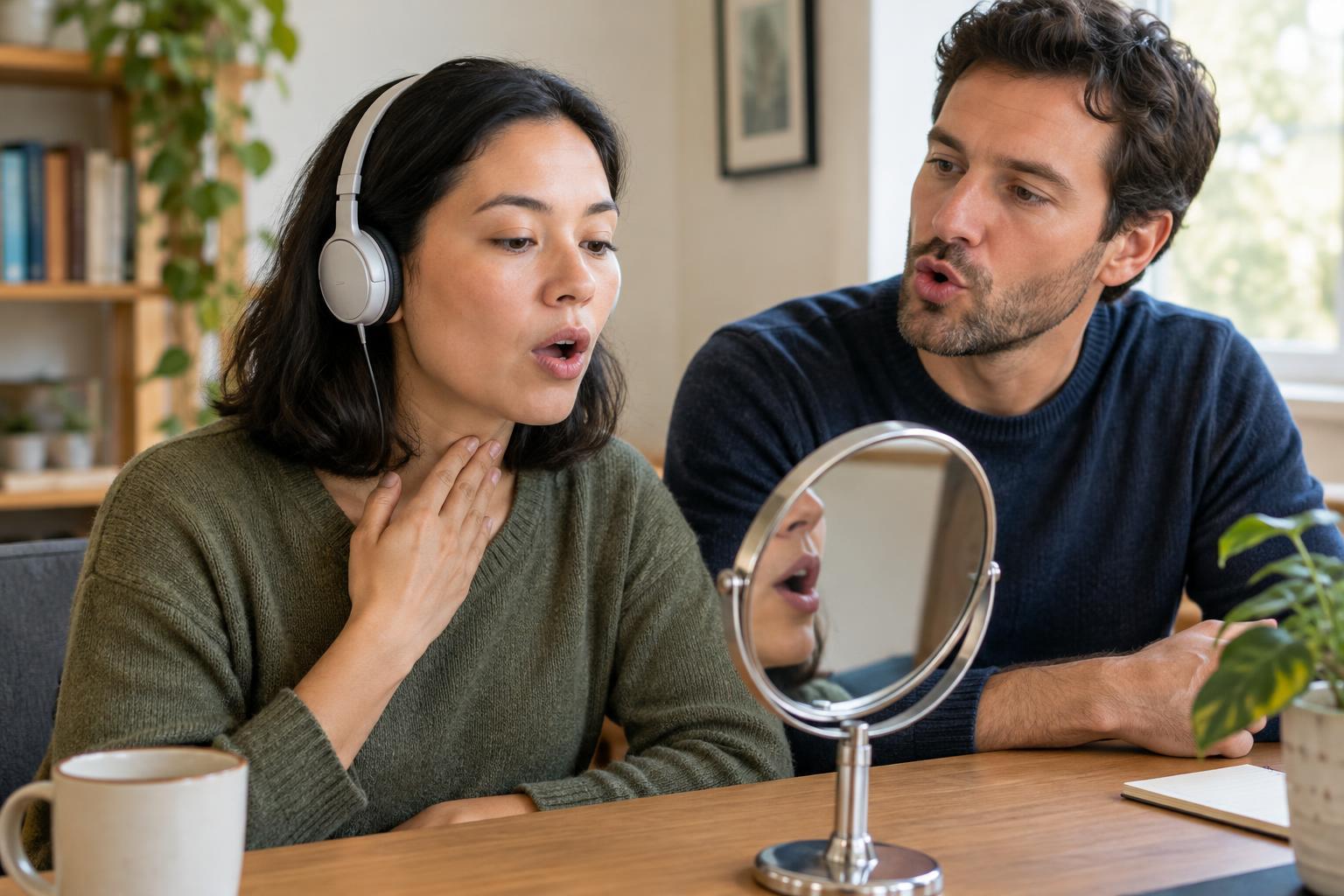
Listening and speaking reinforce each other. Once you can notice something about a sound, explore how your mouth might make it. Pay attention to the position of your tongue, the shape of your lips, the opening of your jaw, and whether air flows freely or meets an obstruction. For some sounds, you may also notice vibration in your throat. You do not need a perfect technical description to benefit from one useful clue.
Watch a clear example of a speaker if one is available, but remember that not every important movement is visible. You can also place a hand near your mouth to notice a burst of air, or gently touch your throat to compare vibration. Try changing one feature at a time. Moving your tongue and changing your lip shape simultaneously makes it harder to tell which adjustment helped.
Use spelling cautiously. Letters are a convenient way to record what you are studying, but the same letter can represent different sounds across languages, and a familiar-looking word may invite an inaccurate pronunciation. Keep an audio example alongside any written note so that your target remains the spoken sound.
Practice a small listening-and-speaking loop
A useful practice loop is short: listen, pause, imitate, record, and compare. Select a word or brief phrase with a clear model. Play it once, then say it at a comfortable pace. Record your attempt on a device and listen to the model and your version one after the other. Choose a single difference to work on, such as vowel length or where the tongue meets the roof of the mouth, before trying again.
Do not expect your recording to sound exactly like the model. Speakers differ in voice and speaking style, so look for the particular feature you are practicing rather than an overall match. If a whole word is difficult, briefly isolate the sound, then put it back into the word. After that, return to a short phrase. This helps you avoid producing an excellent isolated sound that disappears as soon as you speak naturally.
Slow practice can help you locate a movement, but keep listening to examples at a natural pace too. A sound may change slightly with its neighbors. Alternating careful attempts with whole-word listening makes the exercise more relevant to conversation.
Move beyond one word
After a word begins to feel familiar, try the sound in several positions and with different neighboring sounds. A consonant may be easier before one vowel than another; a vowel may be clearer in a short word than in a long phrase. Practicing varied examples helps you learn the sound as a flexible pattern rather than a trick for saying one word.
You can also bring the contrast into meaningful language. Listen for your target sound in a sentence, identify the word that contains it, and repeat the sentence. Then make a sentence of your own using a practiced word. This step connects pronunciation with the words you actually want to use, instead of keeping it separate as a mouth exercise.
In conversation, prioritize being understood over monitoring every detail. If someone does not understand a word, you can repeat it more clearly or rephrase it. Later, note the sound you want to revisit. That gives you a concrete target for your next practice session without interrupting every sentence you speak.
Keep the routine small and specific
A manageable session might focus on one sound contrast, a few recorded examples, and a short phrase. Begin with listening, make several speaking attempts, and finish with another listening check. Save one early recording so you can compare it with a later attempt. Progress may show up first as a better ability to hear a difference, even if producing it consistently takes more practice.
When you get stuck, narrow the task rather than simply repeating the word more times. Try a clearer recording, a different example word, or one physical adjustment. Return to the sound on another day and see whether you recognize it more readily. The aim is not to remove every trace of an accent. It is to build enough awareness and control to hear useful distinctions and speak with greater clarity.