Start with a decision, not a grid
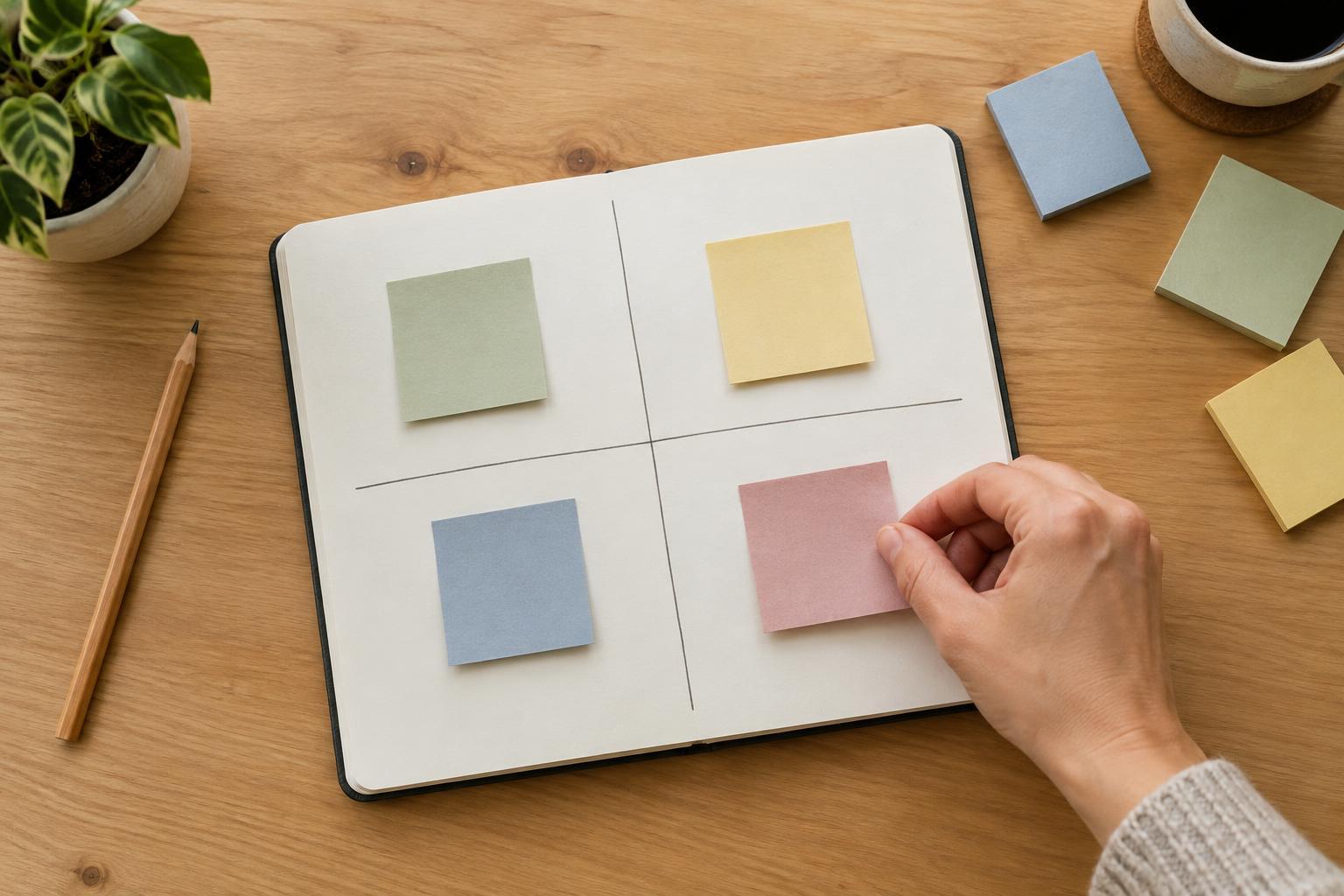
An impact-and-effort matrix is a simple way to compare possible actions. Draw a square, split it into four parts, and label the horizontal direction “effort” and the vertical direction “impact.” Ideas near the top may make a larger difference; ideas toward the right may take more work. The grid does not tell you which idea is best. It helps you see what you believe about your options so you can make a more deliberate choice.
Before placing anything on the grid, name the decision you are making. “How can I improve my learning?” is too broad to compare usefully. “What could I change about my weekly reading routine this month?” gives you a clearer basis for judgment. List a handful of ideas that address the same goal, such as setting aside a regular reading slot, keeping a question list, joining a discussion group, or making brief notes after each session. Comparing ideas with different goals can make the matrix look tidy while leaving the real decision unresolved.
Define impact and effort for your situation
Impact means progress toward the goal you named, not how impressive an idea sounds. For a reading routine, you might define high impact as making it easier to finish and understand the material you chose. Effort includes more than the time spent doing the activity: consider preparation, money, coordination, and the attention needed to keep it going. A discussion group, for example, may offer useful conversation but require scheduling with other people. Brief notes may be easier to start but still take consistent attention.
Pick a time frame before you judge the options. An idea that is manageable for one week may be demanding as a long-term habit. You do not need precise scores; “relatively high” and “relatively low” are enough to begin. If two ideas seem close, write down why. Those reasons are often more useful than their exact positions on the page.
Place ideas, then question their positions
Write each idea on a separate note or line so you can move it. Place the ideas in relation to one another rather than treating the midpoint as a scientific cutoff. A regular reading slot might land in the high-impact, low-effort area if your main obstacle is forgetting to begin. If your schedule changes often, that same idea might require more effort than expected. The placement depends on your circumstances.
The four areas suggest different responses. High-impact, low-effort ideas are often sensible first trials. High-impact, high-effort ideas may deserve a plan, a smaller version, or help from others. Low-impact, low-effort ideas can be worthwhile if they are easy and support another goal, but they need not displace stronger options. Low-impact, high-effort ideas are candidates to pause or drop. None of these labels is a verdict: an idea may have a benefit your two axes do not capture.
Look especially closely at ideas you feel strongly about. Are you rating the impact based on what the action will do, or on how appealing it sounds? Have you included the effort of maintaining it? What would have to be true for the idea to work? Writing one short assumption beside each promising option makes the matrix a tool for thinking rather than a way to justify a choice you already made.
Choose a small test instead of a permanent commitment
Once you have compared the ideas, select one action you can test. Suppose brief notes look promising. You could write three sentences after each reading session for two weeks: one about the main point, one about a question, and one about what you might revisit. This is easier to evaluate than a vague promise to “take better notes.” Decide in advance what you will notice, such as whether the notes help you recall the reading and whether you can keep the habit without disrupting the session.
A high-effort idea can also become testable when you reduce its scope. Instead of organizing an ongoing discussion group, invite one person to discuss a single article. A small trial gives you information about both impact and effort before you invest more. If it fails, you have learned something useful about the idea or the conditions it needs.
Revisit the grid when you learn more
After the test, move the idea if your experience changes your estimate. Perhaps the notes take less time than you expected but do little to help you remember. Perhaps a conversation takes coordination yet makes difficult material clearer. Update the matrix rather than defending your first placement.
Use the grid as a snapshot, not a ranking that must remain fixed. Priorities, available time, and skills change. The most useful outcome is not a perfectly filled-in square; it is a clear next action, an honest account of your assumptions, and a better basis for the decision that follows.