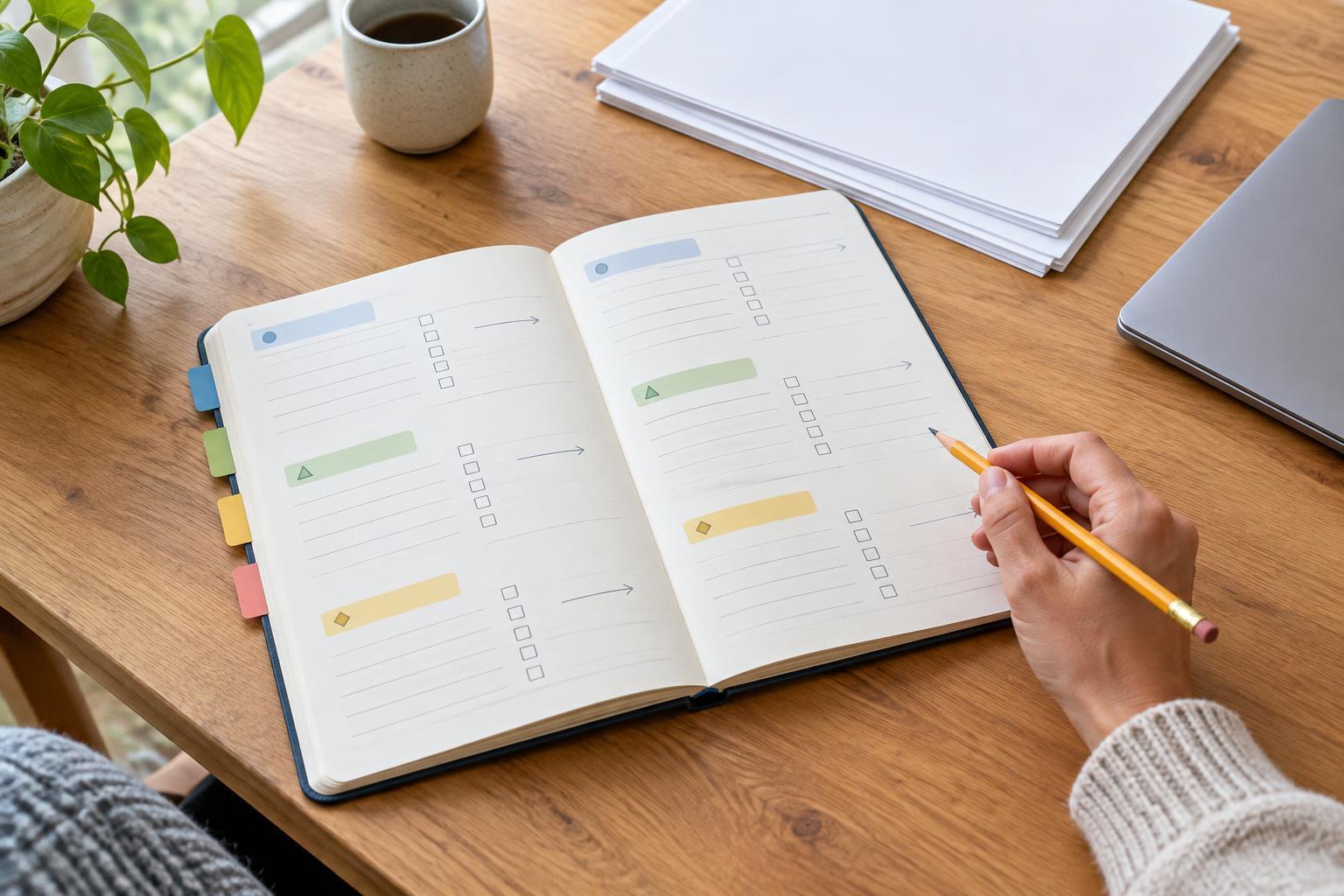
Define what progress would look like
A learning project is easier to assess when its goal describes something you can do. “Learn about photography” leaves plenty of room for curiosity, but it does not tell you what to check. “Choose a camera setting to suit a lighting situation and explain why” gives you a visible task. You can still explore widely; the task simply gives you one way to notice improvement.
At the start, write down two or three abilities you hope to develop. Keep them small enough to demonstrate without staging an exam. If you are learning a language, one ability might be describing a familiar place aloud without reading a script. If you are studying a complex topic, it might be explaining its main idea to someone new to it. Note what a reasonable first attempt would look like, then make one. That early attempt is a reference point, not a verdict.
Collect evidence as you work
Instead of saving all judgment for the end, keep a few dated examples of ordinary work. These might be a short written explanation, a recording of a practice conversation, a sketch, a solved problem, or notes showing how you investigated a question. Choose examples that relate to your goal rather than collecting everything. A small, useful record is more likely to be reviewed than a crowded folder.
Add a brief note to each example: What were you trying to do? What could you complete without help? Where did you pause, guess, or look something up? This separates a finished result from the process that produced it. Two polished pieces can look similar even if one required step-by-step guidance and the other was completed independently. Both are useful evidence, but they show different stages of learning.
Use small demonstrations, not just feelings
Feeling more comfortable with a subject can be encouraging, but familiarity is not always the same as being able to use it. From time to time, try a brief task with your notes closed. Explain a concept in your own words, apply a method to a fresh example, or make a decision and give your reasons. Keep the task close to the ability you want to build. If your goal is to hold a conversation, recognizing words on a page is helpful practice, but speaking is the clearer demonstration.
Repeat a similar task later, rather than memorizing one exact answer. A learner practicing spreadsheets, for example, might organize two different sets of expenses using the same principles. Compare the attempts for specific changes: fewer prompts needed, a clearer explanation, mistakes you can now catch, or more confidence handling an unfamiliar detail. Speed can matter for some goals, but it need not be your main measure.
Invite feedback you can act on
Another person may notice gaps that are hard to see in your own work. When feedback is available, ask a narrow question instead of “Is this good?” You might ask whether your explanation has a confusing step, whether your instructions can be followed without clarification, or which part of a presentation loses its focus. A study partner can respond to those questions without pretending to be an expert.
Treat feedback as information to examine, not an automatic grade. If a comment is vague, ask for an example. If comments conflict, return to your goal and check what each person was responding to. When you work alone, you can still create a little distance: set a draft aside, then review it against a short checklist drawn from your goal. Mark one thing to keep and one thing to revise.
Review, adjust, and keep going
Set a recurring moment to look at your work samples and demonstrations together. Ask what you can now do independently, what still requires support, and whether your original goal remains useful. Write a short summary in ordinary language: “I can explain the basic steps, but I lose track when the example changes.” That sentence tells you more about your next practice session than a score by itself would.
Choose the next task based on the gap you found. If you understand an idea but struggle to recall it, practice explaining it without notes. If you can follow a model but cannot start alone, try a smaller task with fewer prompts. If the work has become easy, make the next example slightly less familiar. Progress does not have to appear as a smooth upward line; a harder task may reveal new difficulties precisely because you are ready to attempt it. The purpose of checking is to make your learning project more responsive, not to turn every practice session into a final test.