Why familiar pages can be misleading
A textbook chapter often feels easier the second time through. The headings look familiar, examples ring a bell, and key terms seem recognizable. That feeling is useful, but it is not the same as being able to explain an idea without the page in front of you. If you need to use the material later, recognition alone may leave you stuck.
Two common habits contribute to this gap: rereading without a purpose and copying large amounts of text into notes. Neither is always a mistake. A second reading can clarify a difficult passage, and an exact definition may be worth recording. The problem arises when these habits take up most of a study session without giving you a chance to find out what you know.
Mistake one: rereading without checking your understanding
It is easy to start again at the top of a chapter when a topic feels difficult. But reading the same pages from beginning to end may keep your attention on the author’s explanation rather than on your own understanding. You can follow an argument while looking at it and still struggle to describe its steps afterward.
Give each return to the text a specific job. Before rereading a section, close the book and jot down what you remember in two or three sentences. Then look for the part you could not explain. Reread that passage slowly, paying attention to the example or distinction that resolves your question. If nothing comes to mind when you close the book, start with the heading and ask, “What question is this section trying to answer?”
Afterward, close the book again and answer that question in your own words. You do not need a polished response. A short, rough explanation shows whether the rereading helped. If you still cannot explain the idea, try working through one example rather than immediately reading the whole section again.
Mistake two: copying instead of making usable notes
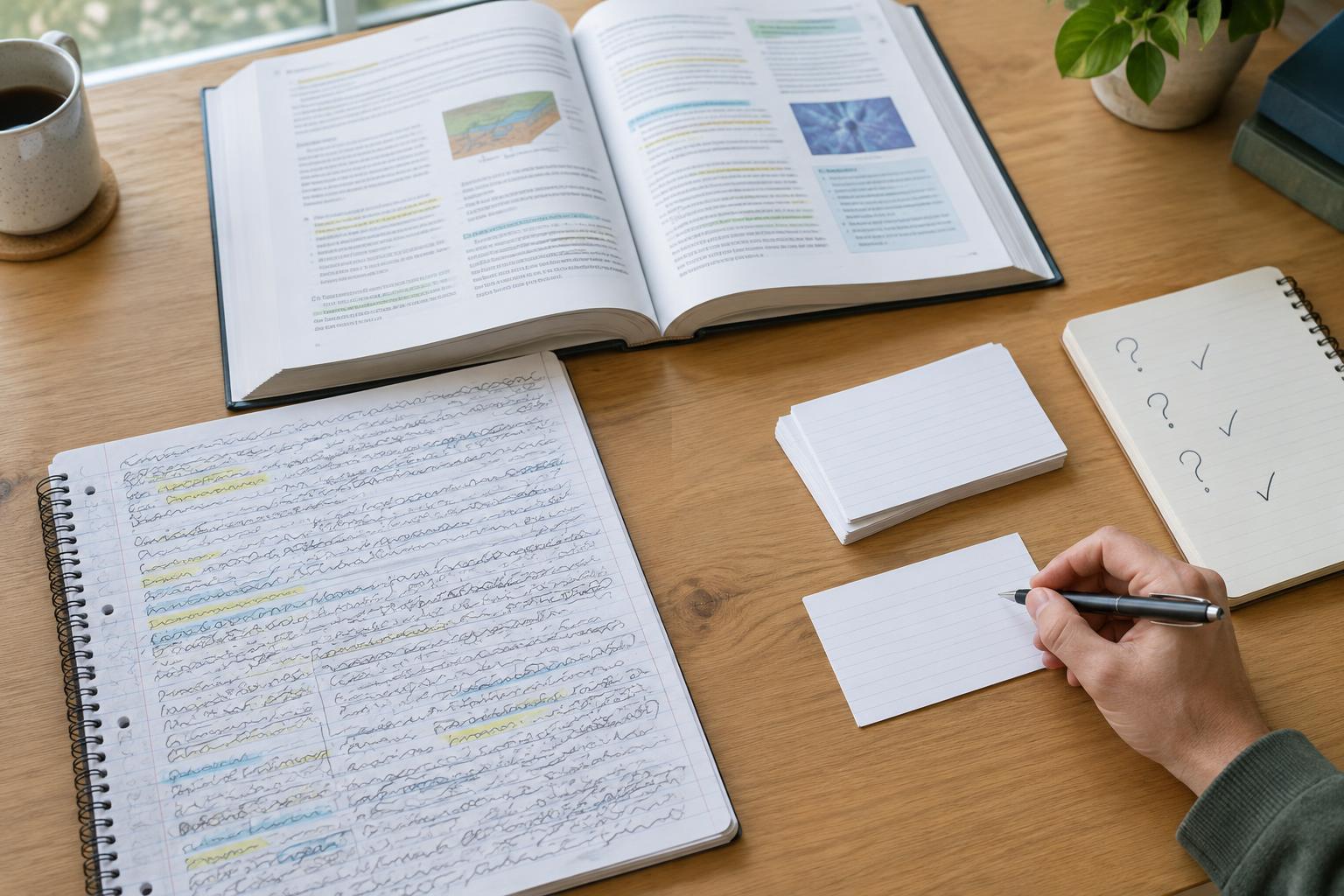
Copying sentences can preserve accurate wording, but it can also turn note-taking into transcription. A page of detailed notes is hard to review if you cannot tell which ideas matter or how they connect. The act of writing may feel busy even when you have made few decisions about the material.
Try limiting each section of notes to its main question, a brief answer, and one example. Keep exact wording when it matters, such as a definition you need to learn precisely, but mark it as a quotation from the textbook. For most explanations, paraphrase after looking away from the page. If you cannot paraphrase without changing the meaning, that is a signal to revisit the passage, not to copy more of it.
Notes become more useful when they prompt an action. Instead of writing only “The author compares two methods,” name the methods and add a question such as “When would I use each one?” That question gives you something to answer during review.
Replace passive review with small self-checks
You do not have to turn every study session into a formal test. After a few pages, pause and cover the text. Explain the main point aloud, sketch a simple diagram, or write a short answer to a question you made from a heading. Then check your attempt against the book and correct what is missing. This keeps the textbook available as a guide while making your own understanding visible.
For a chapter with worked examples, try the next step before reading the author’s solution. For a chapter built around concepts, make up a new example and ask whether it fits. If your answer is incomplete, note the specific gap: a term you confused, a step you skipped, or a connection you could not explain. A precise gap gives your next rereading a purpose.
A practical routine for your next chapter
Begin by scanning the headings and choosing a manageable section. Write one question you expect it to answer. Read the section once, then close the book and answer your question from memory. Check the text, reread only where needed, and make a few notes in your own words. Finish by writing one question you can answer when you next review the chapter.
This routine may feel slower than highlighting or filling pages with notes, especially at first. Judge it by what you can explain and use afterward, not by how many pages you covered. Rereading and note-taking still have a place; they work better when they help you resolve a question, correct an attempt, or prepare a useful prompt for later.