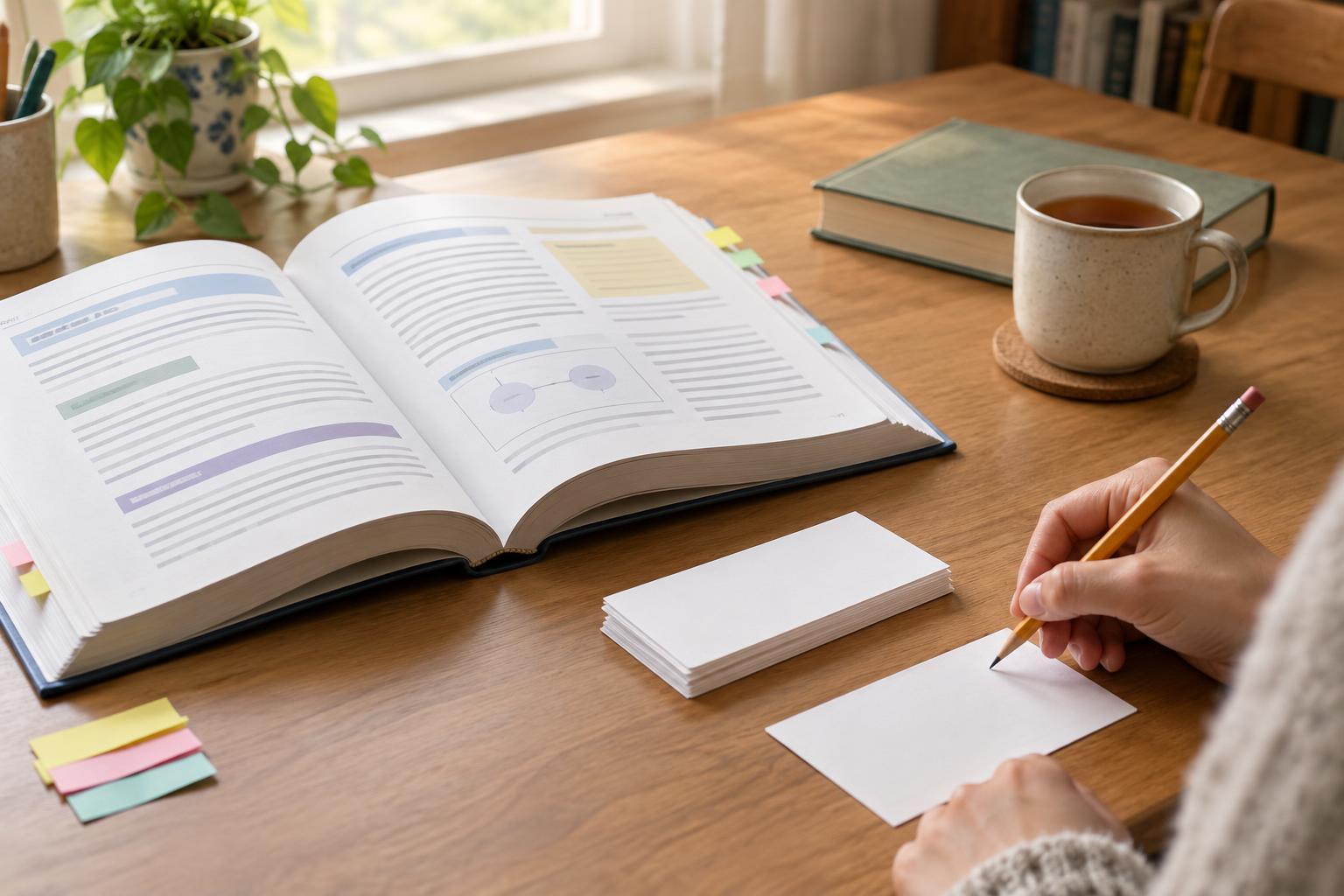
What Cornell notes do for a reader
A textbook chapter can leave you with pages of highlighted sentences but little sense of what to remember. Cornell notes offer a way to separate the main ideas from the details and then check whether you understand them. The method uses three parts of a page: a wide notes area, a narrow cue column, and a summary space at the bottom. You can make the layout on paper or in a digital document.
The notes area holds explanations, examples, and connections. The cue column holds short questions or prompts based on those notes. The summary states the central point in your own words. Together, these parts give you something more useful to review than a copy of the chapter: a record of what you noticed and a set of prompts to test your recall.
Set up a page before you read
Draw a vertical line to divide most of the page into a wide right column and a narrower left column. Leave several lines across the bottom for a summary. At the top, write the chapter title, the section you plan to cover, and any question you hope the reading will answer. If the chapter is long, start a new page for each major section rather than trying to fit everything onto one sheet.
Before taking notes, scan the chapter headings, diagrams, bold terms, and end-of-section questions. This quick preview helps you see how the material is organized. You do not need to understand every term yet. Choose a manageable reading unit, such as one subsection, and focus your notes on that unit before moving on.
Take selective notes as you read
Read a small portion first, then pause to write in the wide notes area. Aim to capture the section’s main claim or concept, a few supporting details, and an example if it clarifies the idea. Use your own words when you can; doing so makes gaps in understanding easier to spot. If a precise definition matters, you can copy it briefly and mark it as a definition rather than treating every sentence as equally important.
For example, in a chapter about ecosystems, your notes might say: “Energy enters through producers; consumers get energy by eating other organisms; some energy is lost as heat at each transfer.” You could add an example from the chapter beneath it. This is more useful than copying a full paragraph because it shows the relationship you need to explain later.
Leave space between ideas, and mark anything confusing with a question mark. If a diagram is central to the explanation, sketch a simple version or note what it shows. You can also record a page number beside a difficult point so you can find the original passage again. The goal is not a perfect-looking page; it is a set of notes you can understand when the book is closed.
Turn notes into cues and a summary
After finishing a subsection, look over the wide column and fill in the narrow cue column. Write questions that your notes can answer, such as “How does energy enter an ecosystem?” or “Why does less energy reach each level?” Short labels can also work for vocabulary, but questions invite you to explain rather than merely recognize a term.
Next, cover the notes area and try to answer each cue aloud or in writing. If an answer is vague, uncover the notes, reread the relevant passage, and improve the cue or explanation. This check is also a chance to correct a mistaken note before it becomes familiar.
At the bottom of the page, write two or three sentences summarizing what the section taught you. A useful summary connects ideas rather than listing headings. For the ecosystem example, it might explain how energy moves through organisms and why that movement matters. If you cannot write a summary yet, identify which part needs another read.
Use the page for review, not storage
Return to your notes after reading and use the cue column to quiz yourself without looking at the answers. Then check the wide column and fill in what you missed. On a later review, try explaining the bottom summary from memory before reading it. You can spend extra time on cues that remain difficult instead of rereading every line.
Avoid filling the page with so many details that you cannot find the chapter’s main ideas. It is also fine to adapt the layout. A dense technical chapter may need more space for diagrams, while a short chapter may fit on one page. What matters is the repeated cycle: read a manageable amount, record its meaning, ask yourself questions, and check what you can explain.